


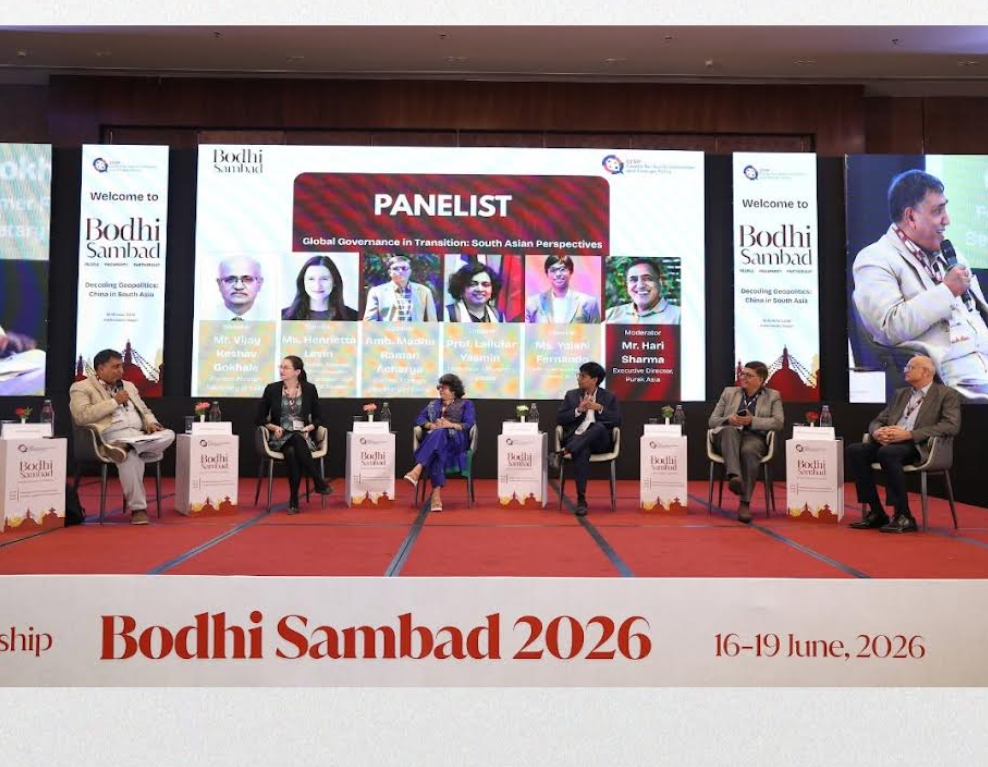
Kathmandu: The third day of the Centre for Social Innovation and Foreign Policy (CESIF)’s Bodhi Sambad, held at Hotel Royal Tulip Kathmandu, shifted focus from domestic economic issues to broader regional and global geopolitical dynamics.
Opening the session, CESIF Executive Chairperson Ambassador Vijay Kanta Karna urged South Asian countries to adopt greater strategic agency rather than remaining passive arenas for great power competition. He highlighted the relevance of the Buddhist “middle path” as a practical analytical framework for statecraft, aimed at maintaining balance amid global polarization. He also outlined four key arenas of geopolitical contestation in South Asia: infrastructure governance, technological sovereignty, civilizational narratives, and the intersection of external influence with domestic politics.
Former Indian Foreign Secretary Vijay Keshav Gokhale, delivering the keynote address, noted that China’s engagement in South Asia has expanded beyond trade into security, cultural influence, and long-term strategic involvement. He emphasized that regional states must prepare for sustained Chinese presence and its implications. He further highlighted China’s Belt and Road Initiative (BRI) and its growing influence in shaping regional governance and digital ecosystems.
A panel discussion on Chinese diplomacy and regional asymmetry examined shifting global governance structures. Speakers highlighted the imbalance between China and smaller South Asian states, the emergence of a China-centric global governance model, and concerns over increasing digital and political influence. Former Nepalese Foreign Secretary Ambassador Madhu Raman Acharya emphasized China’s transformation into a long-term regional actor, while other experts discussed development partnerships, knowledge gaps, and governance challenges across South Asia.
The second panel focused on infrastructure, financial resilience, and small-state agency. Experts warned that despite major infrastructure investments, governance weaknesses remain a critical vulnerability in South Asia. Concerns were raised over rising dependency on foreign financing, regulatory erosion, and bureaucratic paralysis. Speakers emphasized the importance of stronger institutional capacity, improved sequencing of development projects, and independent oversight mechanisms to avoid debt and governance risks.
The third panel explored challenges in the digital domain, including technological dependency, surveillance risks, and information disorder. Experts warned that reliance on foreign digital infrastructure may undermine digital sovereignty and data security. Concerns were raised over monopolistic technology systems, lack of data protection frameworks, and increasing exposure to surveillance technologies. The discussion also highlighted the growing complexity of information warfare and the need for democratic resilience in managing digital narratives.
The final session addressed economic coercion, political volatility, and strategic autonomy in South Asia. Speakers emphasized that smaller states must strengthen internal consensus and governance capacity to effectively navigate external pressures. While cautioning against overdependence on major powers, experts also highlighted opportunities for policy recalibration during periods of domestic political transition. The importance of balanced diplomacy, diversified partnerships, and independent development strategies was strongly underscored.
The day concluded with a shared recognition that South Asian states are not passive actors but can actively shape their geopolitical futures through institutional reform, strategic clarity, and coordinated regional approaches. The CESIF Bodhi Sambad will continue with its final day, focusing on governance models, heritage geopolitics, and regional security frameworks.







प्रतिक्रिया दिनुहोस्