


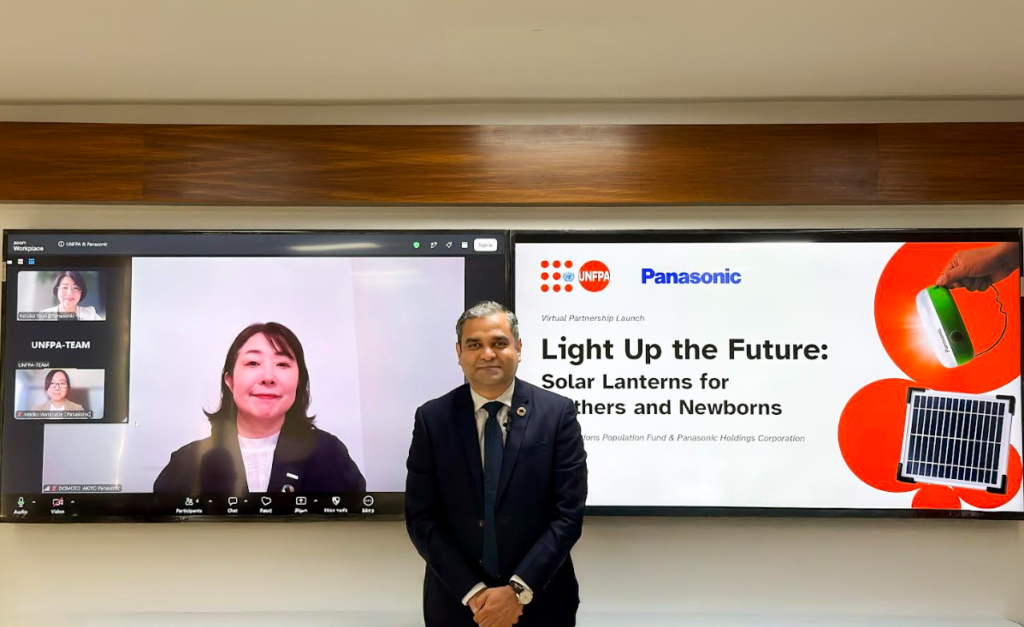
Kathmandu: UNFPA, the United Nations Population Fund, and Panasonic Holdings Corporation have signed an in-kind contribution agreement for the donation of 198 Panasonic solar lanterns to selected health facilities and Female Community Health Volunteers (FCHVs) in Jajarkot District of Karnali Province and Rautahat District of Madhesh Province.
The partnership aims to ensure the continuity of critical and life-saving maternal and newborn health services during emergencies in communities that are increasingly vulnerable to climate-related disasters.
The agreement was signed during a virtual ceremony connecting representatives in Kathmandu and Tokyo. The initiative complements the Government of Japan-funded project, “Improvement of Maternal and Child Health Care Services and Adaptive Capacity in Nepal,” which is being implemented by UNFPA.
The project seeks to address critical gaps in districts where health facilities serving pregnant women and newborns remain highly vulnerable to extreme weather events, including landslides, floods, and severe cold waves.
Speaking during the ceremony, Mr. Sriram Haridass, UNFPA Representative for Nepal, expressed his appreciation to Panasonic for the timely support. “In remote and disaster-prone communities, continuity of essential health services often depends on simple but reliable solutions. These solar lanterns will help frontline health workers continue providing safe maternal and newborn care during power outages and emergencies. This partnership reflects the power of collaboration, and we are grateful to Panasonic for helping strengthen more resilient health systems for the women and families of Nepal,” he said.
Representing Panasonic, Ms. Akiyo Doumoto, General Manager of the Corporate Citizenship Office, highlighted the company’s long-standing commitment to global corporate citizenship. “Through our ‘LIGHT UP THE FUTURE’ initiative, Panasonic is committed to promoting sustainable development and expanding opportunities in education, health, and income generation for off-grid communities worldwide. We are proud to further strengthen our partnership with UNFPA. By delivering clean and reliable light to frontline health facilities in Nepal, we hope to empower local communities and build lasting resilience against the growing impacts of climate change,” she said.
Jajarkot and Rautahat continue to face significant climate and energy challenges. The remote and mountainous district of Jajarkot is still recovering from the 2023 earthquake and experiences limited and unreliable electricity access in many areas. Meanwhile, low-lying Rautahat faces frequent monsoon flooding and lacks adequate backup power systems.
Both districts regularly experience crises that threaten uninterrupted access to essential healthcare services.
The donated Panasonic solar lanterns are expected to support uninterrupted maternal and newborn healthcare services in selected facilities, benefiting an estimated 47,898 women and newborns annually. In addition to improving lighting conditions within health facilities, the lanterns will also support night-time referrals and home visits carried out by Female Community Health Volunteers.
The donation builds on a broader initiative that has already assessed 20 health facilities, refurbished 10 facilities to improve climate resilience, and supported the development of nine climate-adaptive municipal plans.
Since 2022, Panasonic has partnered with UNFPA to deliver solar lanterns to off-grid communities across Africa and Asia. Launched in 2013, Panasonic’s “LIGHT UP THE FUTURE” initiative aims to provide access to light in off-grid regions where the lack of electricity creates significant barriers to daily life.
Working alongside approximately 160 partners, including NGOs, NPOs, and international organizations, Panasonic has delivered around 130,000 solar lanterns across 36 countries worldwide.
The Improvement of Maternal and Child Health Care Services and Adaptive Capacity in Nepal Project is funded by the Government of Japan and implemented by UNFPA Nepal across Jajarkot and Rautahat districts.
UNFPA is the United Nations agency for sexual and reproductive health, working to ensure that every pregnancy is wanted, every childbirth is safe, and every young person’s potential is fulfilled.





प्रतिक्रिया दिनुहोस्