


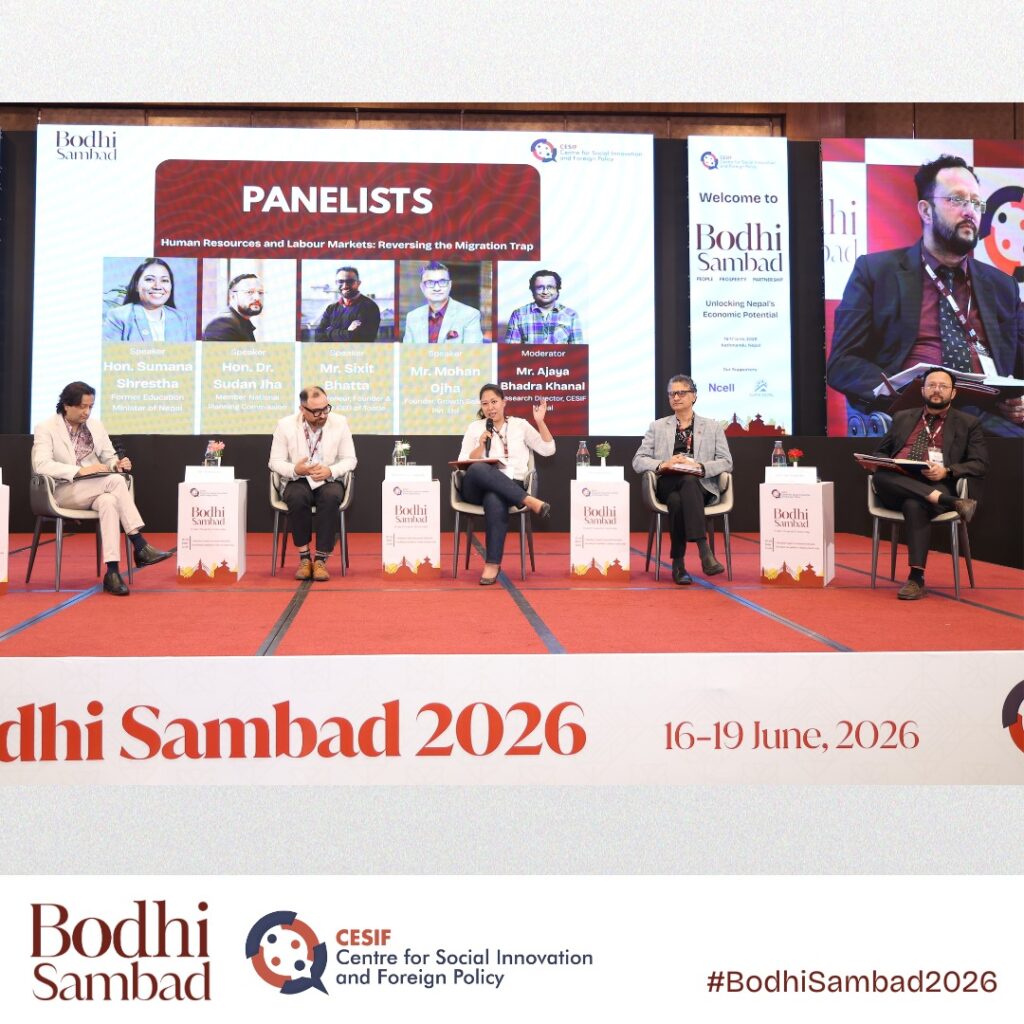
Kathmandu: The second day of Bodhi Sambad 2026, organized by the Centre for Social Innovation and Foreign Policy (CESIF) at Hotel Royal Tulip Kathmandu, shifted the discussion from broad economic reforms to practical strategies aimed at unlocking Nepal’s economic potential.
Featuring four expert panel discussions and a special address by Pranav Kumar Gupta, Resident Representative of the International Monetary Fund (IMF) in Nepal, the event focused on foreign direct investment (FDI), labor migration, energy financing, and digital transformation.
IMF Highlights Nepal’s Reform Progress and Growth Potential
Delivering the keynote address, Pranav Kumar Gupta highlighted the resilience of Nepal’s economy despite political uncertainty, domestic unrest, and global economic shocks.
Gupta noted that Nepal had successfully completed the seventh and final review of its Extended Credit Facility (ECF) programme and was steadily progressing toward economic recovery. While economic growth in fiscal year 2025/26 slowed to around 3 percent, he expressed optimism about the country’s medium-term outlook, citing the completion of the political transition and the government’s expansionary fiscal policy as positive factors for growth in fiscal year 2026/27.
He also praised Nepal’s progress in structural reforms, including modernization of monetary operations, strengthening financial sector oversight through loan portfolio reviews, and improving governance and fiscal transparency.
According to Gupta, maintaining reform momentum, improving bank lending practices, and prioritizing targeted social spending will be critical to sustaining macroeconomic stability and resilience.
Panel Calls for Reforms to Attract Foreign Investment
The first panel discussion, “Multinationals’ Reluctance to Enter Nepal,” examined the challenges preventing multinational corporations from investing in Nepal.
Birendra Raj Pandey, President of the Confederation of Nepalese Industries (CNI), warned of increasing de-industrialization, noting that manufacturing now contributes less than five percent to Nepal’s economy. He pointed out that while competing countries approve investments within one or two months, bureaucratic procedures in Nepal can take up to ten months.
Former Industry Secretary Ambassador Chandra Ghimire called for a shift from traditional political diplomacy to target-driven economic diplomacy. He argued that Nepal’s diplomatic missions should be assigned measurable investment targets and encouraged to build direct relationships with international business chambers.
Representatives from multinational businesses emphasized the importance of policy predictability and investment security. Saibal Ghosh, Co-Convenor of the Indian Business Forum, said global investors assess country risk and brand protection before considering market opportunities. He noted that rigid labor regulations, high taxes, and delayed government payments continue to discourage international companies from entering Nepal.
The panel concluded that Nepal must ensure policy stability and create a more supportive regulatory environment to compete with neighboring countries for foreign investment.
Experts Discuss Migration, Skills and Artificial Intelligence
The second panel, “Human Resources and Labour Markets: Reversing the Migration Trap,” focused on the factors driving Nepali youth abroad.
Human resource expert Mohan Ojha argued that employers expect graduates to become productive immediately while remaining reluctant to invest in training and skill development.
Former Education Minister Sumana Shrestha highlighted what she described as “credential inflation,” where employers increasingly demand academic degrees for jobs that do not necessarily require them. She argued that this trend encourages students to pursue certificates rather than practical skills and innovation.
Shrestha also emphasized that limited access to working capital continues to hinder startups and discourage entrepreneurship among young people.
Technology and artificial intelligence featured prominently throughout the discussion. Entrepreneur Sixit Bhatta warned that rapid AI-driven automation could eliminate many entry-level coding jobs and called for investment in Digital Public Infrastructure (DPI) and equitable access to AI technologies.
Meanwhile, Dr. Sudan Jha of the National Planning Commission outlined plans to develop 15,000 export-ready AI professionals and stressed the importance of closing Nepal’s digital divide by ensuring equal digital access in remote regions and preserving indigenous knowledge through local-language digitization.
Energy Sector Calls for Financing and Infrastructure Reforms
The third panel, “Energy and Infrastructure: Unlocking Finance and Removing Bottlenecks,” examined the challenges facing Nepal’s energy ambitions.
Ganesh Karki, Immediate Past President of IPPAN, argued that achieving green energy goals would require substantial upgrades to Nepal’s electricity distribution network. He warned that existing infrastructure, particularly in urban areas such as Kathmandu, would struggle to support widespread electrification.
Satish Narayan Joshi, Director of Vrock Company, estimated that Nepal faces an annual financing gap of approximately Rs 100 billion for power grid modernization.
IPPAN member Suman Joshi noted that while domestic developers are increasingly capable of financing conventional hydropower projects, foreign investment remains essential for large-scale projects such as reservoir-based hydropower, green hydrogen production, and private transmission infrastructure.
She cautioned that bureaucratic delays and retrospective policy changes continue to undermine investor confidence.
The discussion also addressed regional electricity trade. Former Nepal Electricity Authority Deputy Managing Director Prabal Adhikari described electricity as a geopolitical commodity and highlighted Nepal’s continued dependence on imported electricity during the dry season despite significant wet-season exports.
Panelists urged the government to remove regulatory barriers, allow greater private-sector participation in electricity trading, and develop a comprehensive national power trade strategy.
Digital Transformation Requires Policy Reform and Infrastructure Investment
The final panel, “Digital Nepal: Infrastructure for Governance and Global IT Services,” examined Nepal’s progress toward becoming a regional technology hub.
Former Nepal Telecommunications Authority Senior Director Anand Raj Khanal noted that internet and 4G connectivity have reached all 77 districts, but policy inconsistencies and regulatory uncertainties continue to discourage large-scale investment in the technology sector.
NTA Director Min Prasad Aryal highlighted ongoing efforts to expand digital infrastructure, including the installation of thousands of kilometers of optical fiber along the Mid-Hill Highway. However, he stressed the need to modernize Nepal’s nearly three-decade-old Telecommunications Act to address contemporary digital challenges.
ICT expert Vishal Upadhyaya observed that while Nepal continues to produce skilled technology professionals, the country lacks critical infrastructure such as advanced data centers, cloud computing ecosystems, and widespread AI adoption.
Digital policy expert Dr. Amrita Sharma noted that Nepal ranks among the lowest-performing countries in South Asia on the Global Innovation Index. She argued that weaknesses in digital trust systems and infrastructure must be addressed urgently if Nepal hopes to become a competitive destination for global IT services.
The panel concluded that Nepal must move beyond incremental reforms and accelerate investments in digital infrastructure, innovation, artificial intelligence, and governance systems to realize its ambitions of becoming a regional digital hub.
Through the discussions, Bodhi Sambad Day 2 highlighted the growing consensus among policymakers, business leaders, and experts that attracting investment, retaining talent, modernizing infrastructure, and accelerating digital transformation will be crucial to Nepal’s long-term economic growth and competitiveness.





प्रतिक्रिया दिनुहोस्