


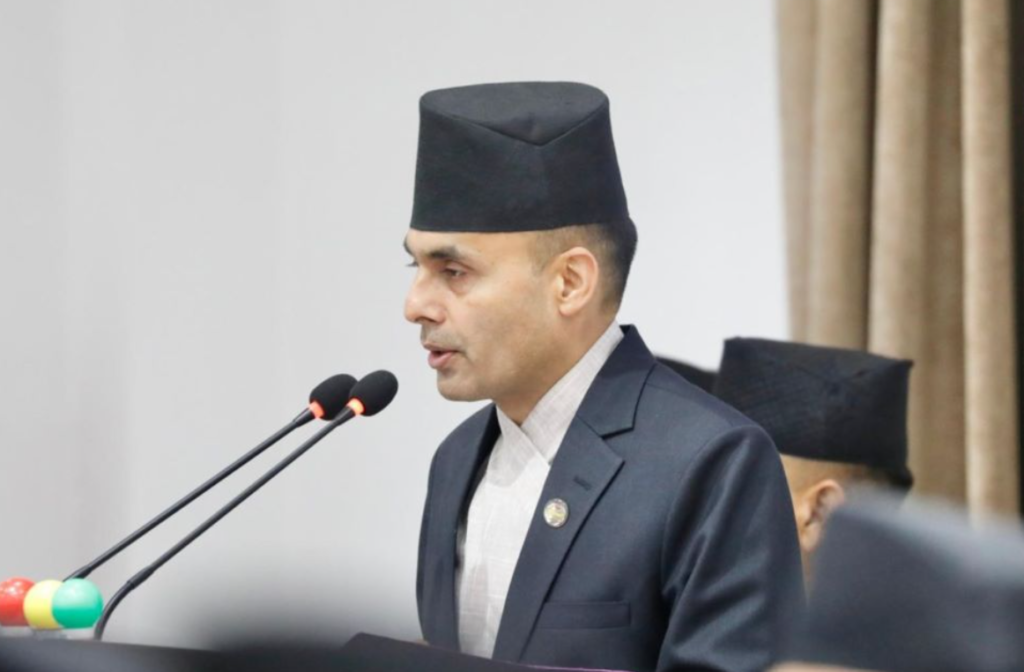
Kathmandu: Minister for Communications and Information Technology Dr. Bikram Timilsina has reaffirmed the government’s commitment to protecting and promoting freedom of expression, press freedom, and citizens’ right to information.
Responding to lawmakers’ queries on the Appropriation Bill 2083 during a meeting of the House of Representatives on Wednesday, the minister said the government has prioritized strengthening the media sector through new laws and policies aimed at making journalism more dignified, responsible, and credible.
Dr. Timilsina informed Parliament that the government’s policies, programmes, and budget for fiscal year 2083/84 have identified mass communication, telecommunications, postal services, film, and printing as priority sectors. The Ministry of Communications and Information Technology has been allocated a budget of Rs 5.93 billion for the upcoming fiscal year.
According to the minister, public media institutions including Nepal Television, Rastriya Samachar Samiti (RSS), Gorkhapatra Corporation, Radio Nepal, and the Film Development Board operate through a combination of internal revenue and government grants, while the Nepal Telecommunications Authority and Nepal Telecom are financially self-sustaining.
Commitment to Press Freedom and Journalists’ Rights
Addressing concerns raised by lawmakers regarding private media sustainability, journalists’ rights, social media regulation, digital safety, and misinformation, Dr. Timilsina stated that the government would not suppress freedom of expression or press freedom.
He said the National Information Commission has been strengthened to ensure citizens’ access to information and improve accountability and transparency among public institutions.
The minister also emphasized the government’s concern regarding journalists’ minimum wages and labor rights. Media organizations have been required to submit payroll details to the Department of Information and Broadcasting in order to access government services and benefits.
“The government is committed to preventing the financial exploitation of journalists, and workplace safety remains equally important,” he said.
Dr. Timilsina further argued that operating media-related unions and organizations along political party lines runs counter to the values of press freedom and international standards.
For the upcoming fiscal year, the government has allocated:
- Rs 5 million for media-related organizations
- Rs 2.1 million for investigative journalism fellowships
- Rs 2.4 million for media innovation and fact-checking initiatives
- Rs 4 million for complaint management and transparency programmes
Telecommunications Expansion a Priority
Responding to concerns about mobile and internet connectivity in rural, hilly, and mountainous regions, the minister said expanding quality and affordable telecommunications services remains a top government priority.
He informed lawmakers that amendments to the Telecommunications Act are being prepared, while regular network monitoring, drive testing, and optimization efforts are underway to improve service quality.
The government is also accelerating the use of the Rural Telecommunications Development Fund (RTDF) through the Nepal Telecommunications Authority to expand communications infrastructure in underserved areas.
According to Dr. Timilsina, expansion of BTS towers, e-NodeB infrastructure, mobile towers, and Fiber-to-the-Home (FTTH) services is continuing nationwide. FTTH connectivity has already reached all 77 district headquarters and is now being extended to municipalities and rural municipalities.
He noted that broadband internet services have reached:
- 6,743 ward centers
- 4,272 health institutions
- 5,341 community secondary schools
Through Nepal Telecom alone, 763 new telecommunications infrastructures have been installed during the current fiscal year, including:
- 2G services in 162 locations
- 3G services in 13 locations
- 4G services in 588 locations
The procurement process for an additional 1,597 BTS and e-NodeB units has already been initiated for the next fiscal year.
Strengthening Disaster Communication and Postal Services
The minister said early warning systems are being effectively implemented through public broadcasting institutions and SMS alerts distributed by telecommunications service providers during natural disasters.
On postal sector modernization, Dr. Timilsina announced that Rs 25 million has been allocated to establish information technology infrastructure in 50 additional local-level post offices next year. Further investment will be made through the Nepal Digital Transformation Project.
Currently, Nepal Post delivers a range of official documents, including passports, driving licenses, land ownership certificates, laboratory reports, ATM cards issued by Rastriya Banijya Bank, and health insurance materials directly to citizens.
EMS services have been expanded to all districts with air connectivity, while international express mail services now connect 39 countries and parcel services reach 93 destinations across 71 countries. Door-to-door postal services are available in 62 districts.
Digital Transformation and Cyber Security
The minister emphasized that the government is prioritizing digital transformation and cyber security through the Nepal Digital Transformation Programme.
He said efforts will focus on strengthening digital public infrastructure, improving government services, and enhancing national cyber security systems.
The newly certified digital infrastructure ecosystem, combined with expanded connectivity, is expected to support economic growth, public service delivery, education, and social development.
Film and Security Printing Initiatives
Dr. Timilsina informed lawmakers that procedures for film shooting in Nepal have been simplified to promote international film production and strengthen Nepal’s creative sector.
Construction of a modern film studio in Banepa, Kavrepalanchok, has already begun and is targeted for completion within the next fiscal year.
A new film-related bill has been registered in the Federal Parliament and is currently under discussion in the House of Representatives committee. The government has allocated Rs 35 million in incentive grants to support films promoting Nepal’s cultural and national values.
In the security printing sector, the minister said infrastructure is being developed under the Security Printing Act, 2081 to enable domestic production of sensitive printed materials.
Nepal has already begun printing postage stamps and driving licenses domestically. Of the 2.9 million driving licenses awaiting production, 1.8 million have already been printed, with the remainder expected to be completed within the current fiscal year.
The government has allocated Rs 3.24 billion for the Security Printing Centre in fiscal year 2083/84 and aims to establish a system for issuing driving licenses immediately upon demand in the future.
Concluding his remarks, Dr. Timilsina said efficient budget utilization and timely implementation of programmes would be key priorities, expressing confidence that the planned initiatives would contribute significantly to Nepal’s digital transformation and communications sector development.







प्रतिक्रिया दिनुहोस्