


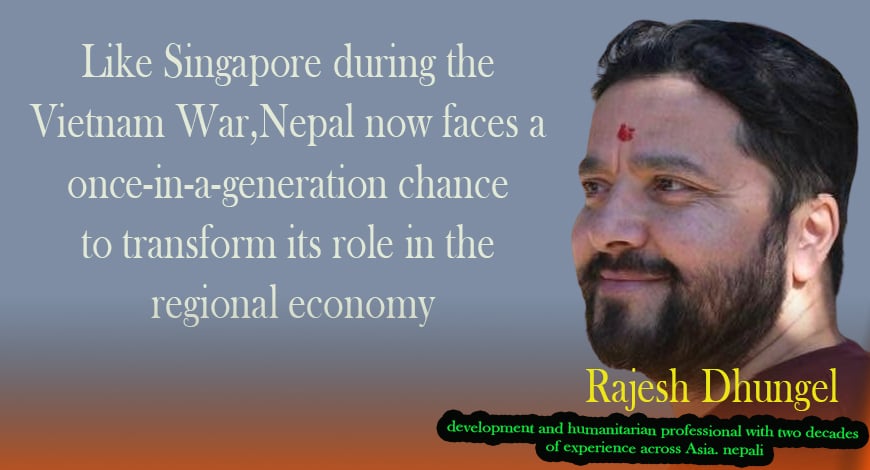
-By Rajesh Dhungel
Nepal finds itself in a unique position grouped with Bhutan, Afghanistan, and the Maldives as one of the few SAARC nations favorably positioned under the U.S. tariffs framework. Amid regional economic volatility, this positioning offers a rare comparative advantage for Nepal’s exports and potential to attract foreign direct investment (FDI). But capitalizing on this opportunity requires more than just favorable conditions it demands vision, strategy, and bold policymaking.
History offers a compelling parallel. During the Vietnam War (1955–1975), a small island nation not directly involved in the conflict transformed itself into an economic powerhouse. Singapore, under the astute leadership of Lee Kuan Yew, leveraged geopolitical tensions to its advantage, emerging as Southeast Asia’s commercial and strategic hub. While war is never a welcome circumstance, Singapore’s trajectory illustrates a crucial lesson: with strategic geography, political stability, and pragmatic economics, even turmoil can be turned into opportunity.
Turning Crisis into Opportunity
During the height of the Vietnam War, Singapore’s ports became crucial logistical centers, handling shipments for American forces. Shipyards thrived, hotels were filled with U.S. servicemen on R&R breaks, and global corporations relocated to Singapore, escaping the uncertainty of Indochina. All this occurred in a country with few natural resources but with a leadership that understood the value of geography, timing, and trust.
Fast forward to today: Nepal sits between two of Asia’s largest economies, India and China, locked in a complicated relationship defined by both cooperation and competition. Border disputes, infrastructure rivalries, and shifting alliances dominate the narrative. Yet, this very positioning offers Nepal an unprecedented chance to play a pivotal role—as a strategic corridor for trade, energy, and diplomacy in Asia.
The Nepal Opportunity
Rather than viewing its geography as a constraint, Nepal must treat it as its greatest economic asset—much like Singapore once did. But to do so, four key pillars must be addressed:
1. Political Stability and Clean Governance
Investors gravitate toward countries with predictable governance, low corruption, and streamlined bureaucracies. Lee Kuan Yew’s relentless pursuit of clean, efficient administration laid the foundation for Singapore’s success. Nepal must emulate this by fostering institutional stability, combating corruption, and ensuring that internal political squabbles don’t deter long-term economic planning.
2. Becoming a Regional Trade and Logistics Hub
As China’s Belt and Road Initiative (BRI) and India’s connectivity drive reshape Asian trade routes, Nepal can serve as a transit nation bridging South and Central Asia. But for that, infrastructure must move beyond token track openings and seasonal roads. Nepal must invest in high-capacity highways, modern rail links, efficient customs systems, and digital logistics platforms to be taken seriously as a trade hub.
3. Building Specialized, Competitive Industries
Nepal doesn’t need to industrialize in every direction but it must identify and nurture its strategic sectors: clean hydropower, eco- and cultural tourism, IT services, and green manufacturing. These industries hold natural and comparative advantages. With targeted policies and incentives, Nepal can position itself as a niche exporter like Singapore did with electronics and finance.
4. Balanced and Independent Diplomacy
Singapore’s Cold War diplomacy offers a masterclass: maintain relations with both sides without becoming anyone’s pawn. Nepal’s own non-alignment policy must be strengthened with proactive diplomacy that secures economic and technological cooperation from both India and China without compromising sovereignty or credibility.
From Landlocked to Land-Linked
Nepal’s path won’t be easy. It will require decades of commitment, leadership continuity, and public-private synergy. But if Nepal can think beyond short-term wins and embrace a strategic vision, its “in-between” geography could become a launchpad, not a limitation.
Singapore transformed itself from a struggling port city into a global financial center in the span of a few decades. With the right playbook, Nepal too can defy the odds—emerging not as a nation caught between giants, but as a bridge that connects them.





प्रतिक्रिया दिनुहोस्